
Her Pad Project
Challenge:

In Mwanza menstruation is perceived a taboo and has met many negative cultural hindrances. Girls suffer from stigma and lack of facilities to help them cope with physical and psychological pains they undergo during their menstrual periods. Some use methods such as rags and cow dung which are very unhygienic and could lead to infections. This leads to many of them missing school for few days as they are uncomfortable to attend school or embarrassed by boys from staining their school uniforms.
Academic performance correlates closely with school attendance, and absenteeism. In Tanzania, Girls miss out going to school 60 days a year, or 5 days a month staying at home waiting for their period to end and that adds up to 20% of school year skipped because they cannot afford the disposable pads. Once girls start missing school, they are more likely to be exposed to other risks such as early pregnancy and marriage, HIV/AIDS, and female genital mutilation.
This is because girls who cannot afford disposable sanitary towels are at more risk of manipulation by men for sexual relationship who promise to provide them with the money to buy the pads.
Our Solution

We are Implementing HER PAD project to deliver holistic menstrual health hygiene education and support for young girls (aged 9-17 years) so that they can manage their menses at home and school with health safety and dignity resulting in increased school attendances and academic performances.

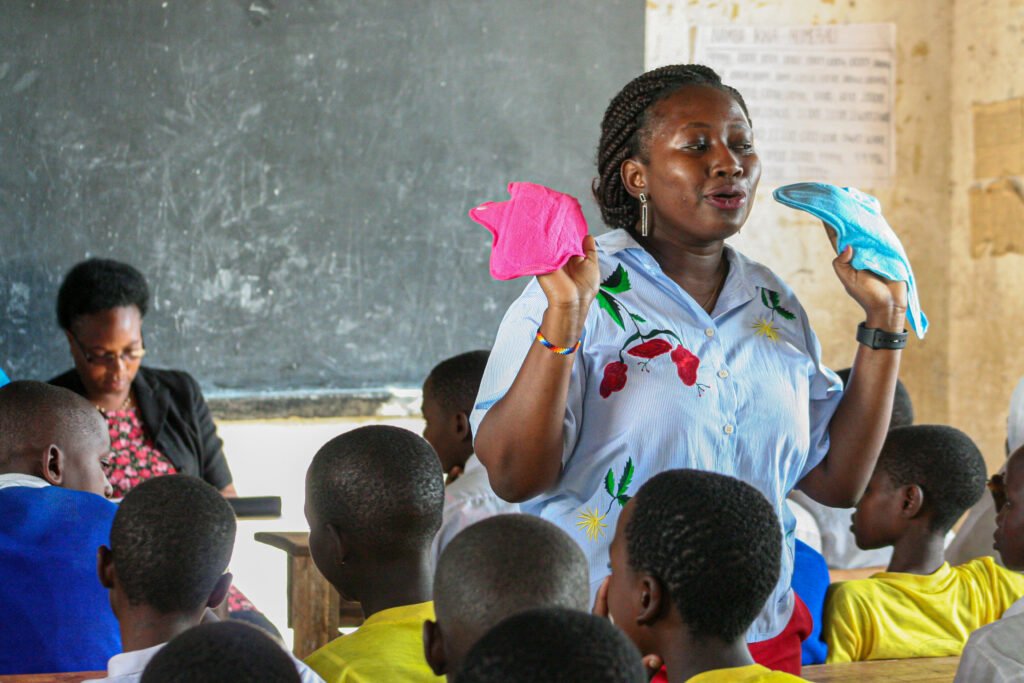
The project also trains schoolgirls to manufacture simple re-usable and environmentally friendly sanitary pads using double absorbent cotton cloth material and plastic lining. The pads are re-washable that can be used up to a year, they are sustainable and portable providing comfort to schoolgirls. Boys and male teachers also be involved in the project to break the poor perceptions and cultural beliefs on menstruation that led to stigma.
By proving information and access to MHM resources, the project aims to educate and empower girls to manage their periods comfortably and safely while at school.


Challenge:
In Mwanza menstruation is perceived a taboo and has met many negative cultural hindrances. Girls suffer from stigma and lack of facilities to help them cope with physical and psychological pains they undergo during their menstrual periods. Some use methods such as rags and cow dung which are very unhygienic and could lead to infections. This leads to many of them missing school for few days as they are uncomfortable to attend school or embarrassed by boys from staining their school uniforms.
Academic performance correlates closely with school attendance, and absenteeism. In Tanzania, Girls miss out going to school 60 days a year, or 5 days a month staying at home waiting for their period to end and that adds up to 20% of school year skipped because they cannot afford the disposable pads. Once girls start missing school, they are more likely to be exposed to other risks such as early pregnancy and marriage, HIV/AIDS, and female genital mutilation.
This is because girls who cannot afford disposable sanitary towels are at more risk of manipulation by men for sexual relationship who promise to provide them with the money to buy the pads.
Our Solution
We are Implementing HER PAD project to deliver holistic menstrual health hygiene education and support for young girls (aged 9-17 years) so that they can manage their menses at home and school with health safety and dignity resulting in increased school attendances and academic performances.
The project also trains schoolgirls to manufacture simple re-usable and environmentally friendly sanitary pads using double absorbent cotton cloth material and plastic lining. The pads are re-washable that can be used up to a year, they are sustainable and portable providing comfort to schoolgirls. Boys and male teachers also be involved in the project to break the poor perceptions and cultural beliefs on menstruation that led to stigma.
By proving information and access to MHM resources, the project aims to educate and empower girls to manage their periods comfortably and safely while at school.